OUTKICK SPORTS


Focusing while juggling note‑taking and follow‑ups can be extremely difficult with ADHD.
In modern work environments, meetings haven’t just increased in number. For professionals with ADHD, they’ve become one of the hardest parts of the working day.
More decisions are being made in real time. More collaboration is happening live. And for individuals who already manage significant cognitive load, the ability to stay fully present in those moments is becoming a competitive advantage — one that’s harder to access than most people realize.
But there’s a problem.
For many professionals with ADHD, meetings demand two things at once that directly compete with each other; listening and writing.
Both require sustained attention. And for an ADHD brain, splitting focus between the two often means doing neither well.
“I can follow the conversation or I can take notes,” one professional explained. “I’ve never been able to do both at the same time. Something always gets lost.”
That trade-off has become one of the most consistent friction points for ADHD professionals in knowledge work.
Important points are raised and then gone before they can be written down. Action items are captured partially, or not at all. And the mental effort of trying to track everything in real time leaves people exhausted before the next meeting has even started.
Over time, the cost compounds.
Hours are lost retracing discussions. Missed follow-ups create the impression of disorganization. And the gap between how capable someone is and how they appear to be performing quietly widens — not because of ability, but because the tools available weren’t designed for the way their brain works.
Traditional solutions haven’t kept up.

Note‑taking and follow‑ups are becoming harder as workloads increase in the industry.
Note-taking strategies, templates, and organizational systems help some people some of the time. But they still require the same divided attention that creates the problem in the first place.
For most ADHD professionals, the issue isn’t effort or intention. It’s that the act of capturing a conversation competes directly with the act of understanding it.
So people turn to the most obvious alternative: audio recording.
At first glance, it seems like a simple fix. Open an app, hit record, focus on the conversation.
But even with a clean recording, the problems remain.
Recordings pile up. Reviewing them requires sustained focus that isn’t always available. And the gap between capturing a conversation and actually doing something with it remains as wide as ever.
Recordings also can easily be interrupted by incoming calls, other apps or just accidentally touching the screen.
“I had recordings going back months,” one user said.
“I never listened to a single one. The intention was there. The follow-through wasn’t.”
This has led to a shift in how some professionals are thinking about productivity tools.
Instead of capturing more, the focus is moving toward removing the need to capture at all — freeing attention entirely for the conversation itself.
One device that has started to gain attention in this space is Pocket.
This AI hardware start-up, growing quickly out of San Francisco, combines a practical physical product with the full range of AI integration now available.
Unlike traditional apps or recording tools, it separates the act of capturing information from the distractions of a phone.
The device attaches directly to the back of a phone and can begin recording with a single tap — no apps, no setup, and no interruption to the conversation.
But users say the real value comes after the meeting ends.
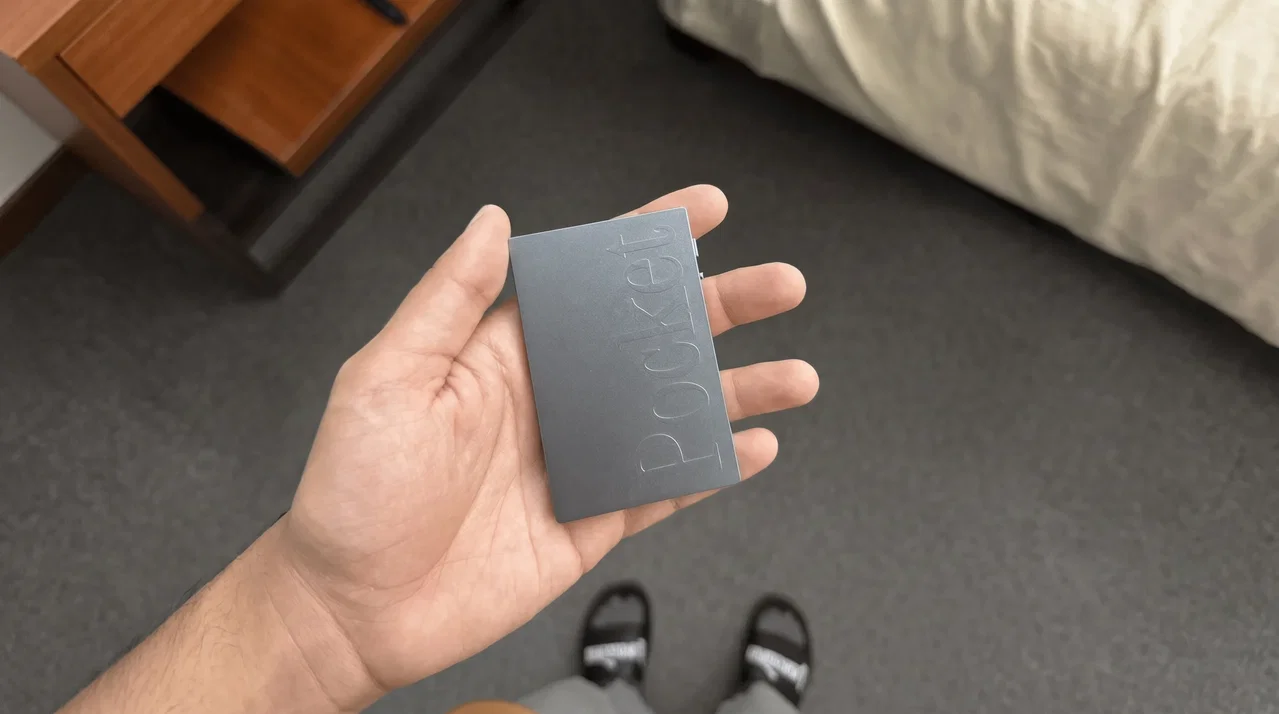
A space grey pocket device in a user's hand, very popular for its thin and sleek form factor.
Instead of producing another audio file, the system converts conversations into structured outputs.
Full transcripts are generated automatically. Discussions are summarized. Key decisions are highlighted. Action items are clearly outlined.
For ADHD professionals, the shift has been significant.
“I’m actually present now,” one user said.
“I’m not trying to hold everything in my head. I just listen, and Pocket handles the rest.”
Another factor frequently mentioned is the reduction in post-meeting mental load.
With summaries and action items generated automatically, the cognitive work of processing a conversation no longer has to happen in the room — or immediately after it.
“The thing that always got me was the write-up,” one user noted. “By the time the meeting was over, I was already behind. Now I walk out with everything done.”

A pocket user can seamlessly record conversations, be it in-person meetings or phone calls
As awareness of ADHD in professional environments continues to grow, so does demand for tools designed around the way different brains actually work.
Tools like Pocket are emerging as part of that shift — not by adding more features, but by removing the friction that makes meetings so costly for so many.
Because increasingly, the question isn’t how to take better notes.
It’s whether the tools available were ever designed for the people who need them most.
For more information, visit Pocket here.
Report published on | May 15, 2025
