OUTKICK SPORTS


Note taking doesn't help in remote work when everyone has their own version of a meeting and its takeaways.
In modern work environments, meetings haven’t just increased in number. For distributed and remote teams, they’ve become the primary place where work actually happens.
More decisions are being made on calls. More collaboration is happening across time zones. And for many professionals, the ability to capture those moments accurately — and share them clearly with people who weren’t in the room — is becoming a critical operational skill.
But there’s a problem.
Most remote teams aren’t capturing conversations well enough to bridge the gap.
They’re relying on partial notes, unreliable memory, and follow-up messages that repeat half of what was said without capturing any of the nuance.
“Someone always misses the call,” one remote team lead explained.
"And whatever gets written up in the notes never really captures what actually happened."
That gap has become one of the biggest hidden inefficiencies in distributed work.
Important decisions are made on calls and then filtered through whoever happened to be taking notes that day. Context gets lost between time zones. Teams that should be aligned keep operating on slightly different versions of the same conversation.
Over time, the cost compounds.
Hours are lost in follow-up messages clarifying what was agreed. Projects slow down because action items weren’t clearly communicated to everyone who needed them. And the friction between a conversation and execution quietly grows — invisible until it becomes a pattern.

Note‑taking and follow‑ups are becoming harder as workloads increase in the industry.
Traditional solutions haven’t kept up.
Shared documents, meeting summaries, and post-call emails help some of the time. But they’re only as good as whoever writes them — and they still require someone to split their attention between the conversation and the capture.
For most remote professionals, calls move fast and decisions happen in real time. There’s rarely a dedicated note-taker, and the burden of documentation falls on whoever remembers to do it afterward.
So people turn to the most obvious alternative: audio recording.
At first glance, it seems like a simple fix. Record the call, share the file, let people catch up in their own time.
But even with a clean recording, the problems remain.
Recordings pile up. Files are labeled with timestamps that quickly lose meaning. And listening back to an hour-long call to find a two-minute decision is not a realistic workflow for anyone on a distributed team.
Recordings also can easily be interrupted by incoming calls, other apps or just accidentally touching the screen.
“We had recordings of every meeting for six months,” one team lead said.
"Nobody listened to them. The information was there. It just wasn’t accessible."
This has led to a shift in how some remote teams are thinking about communication.
Instead of trying to capture more, the focus is moving toward making captured information immediately usable — structured, searchable, and shareable without additional effort.
One device that has started to gain attention in this space is Pocket.
This AI hardware start-up, growing quickly out of San Francisco, combines a practical physical product with the full range of AI integration now available.
Unlike traditional apps or recording tools, it separates the act of capturing information from the distractions of a phone.
The device attaches directly to the back of a phone and can begin recording with a single tap — no apps, no setup, and no interruption to the conversation.
But users say the real value comes after the call ends.
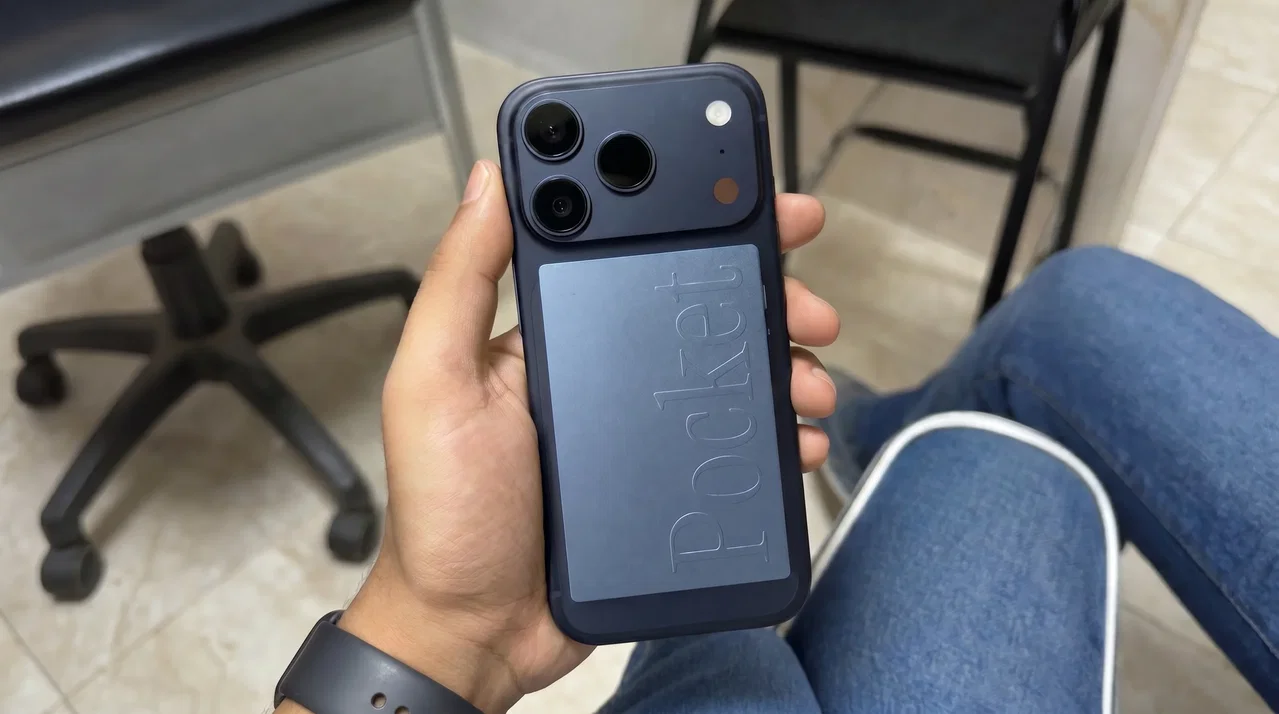
A space grey pocket device in a user's hand, very popular for its thin and sleek form factor.
Instead of producing another audio file, the system converts conversations into structured outputs.
Full transcripts are generated automatically. Discussions are summarized. Key decisions are highlighted. Action items are clearly outlined.
For distributed teams, the impact has been immediate.
“I send the summary to anyone who missed the call and they’re up to speed in two minutes,” one user said.
“It’s changed how we hand off information across time zones.”
Another factor frequently mentioned is the reduction in async back-and-forth.

A pocket user can seamlessly record conversations, be it in-person meetings or phone calls
With a clear, structured record of every conversation, the follow-up messages, clarification requests, and check-ins that typically follow a meeting become largely unnecessary.
“We used to spend as much time after a call as we did on it,” one remote manager noted.
"Now the summary does most of that work automatically."
As remote and hybrid work continues to define how teams operate, the ability to capture and share conversations accurately is no longer a nice-to-have.
Tools like Pocket are emerging as part of that infrastructure — not by adding more features, but by removing the friction between a conversation and everyone who needs to act on it.
Because increasingly, the question isn’t how to take better notes
It’s how to make sure the whole team has them.
For more information, visit Pocket here.
Report published on | May 15, 2025
