OUTKICK SPORTS


Maintaining every written note and extracting value out of them has turned into a serious issue
For professionals managing multiple meetings a day, note-taking has long been considered a necessary part of staying organized.
But for many, the system is starting to show its limits.
In fast-paced work environments where conversations move quickly and decisions are made in real time, capturing everything accurately has become increasingly difficult.
"I’m in three or four meetings a day, sometimes more. There’s no way I can remember everything, especially when they’re back-to-back."
Like many others, Paul Balatine, a marketing director based in Chicago, relied on traditional methods. Pen and paper during in-person meetings. Occasionally a phone for digital notes. But neither option proved reliable.
Handwritten notes were often rushed and difficult to interpret later. “It looked like a code I couldn’t even crack myself,” he said.
Using a phone created a different issue. Even when used for note-taking, it gave the impression of distraction. “People assume you’re not paying attention, even when you are.” As a result, note-taking became less about clarity and more about damage control.Time was spent rewriting notes, verifying details, and following up with colleagues to confirm what was said.
In an attempt to improve accuracy, some turned to recording apps. But this introduced another problem. Audio files quickly accumulated, often labeled only by date and time, with no easy way to search or extract useful information. Reviewing them required additional time that most didn’t have. “It just turned into a backlog I never went through,” Paul noted.
This growing frustration has led to interest in alternative approaches, particularly tools designed to reduce the cognitive load of capturing and organizing information.
One such device gaining attention is Pocket.
At first glance, it appears to function as a compact recording device that attaches to a phone.
However, users report that its primary value lies far beyond recording. The device captures conversations with a single tap, without needing to open apps or manual setup, and works across both in-person and phone-based interactions, thanks to a slide button that activates studio or contact microphones.
But what differentiates it is what happens after the recording.
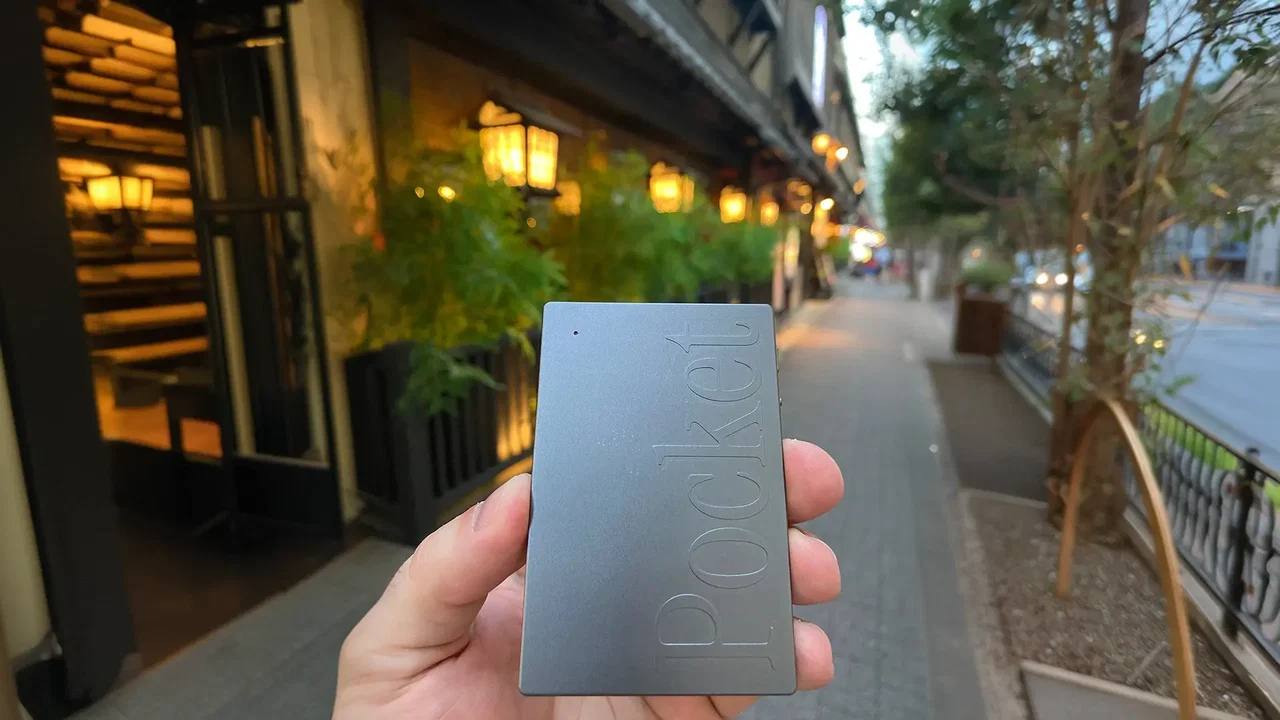
A space grey pocket device in a user's hand, very popular for its thin and sleek form factor.
According to users, conversations are automatically converted into structured outputs, including full transcripts, summarized discussions, highlighted decisions, and clearly defined action items.
“It’s not just another recording,” one user explained. “It actually turns it into something you can use right away.”
The system also prompts follow-up actions, such as scheduling tasks or adding calendar events, helping users move directly from conversation to execution.
Another factor cited by users is the ability to separate the process from their phone.
With notifications and distractions removed, some report being more focused during meetings while still capturing all relevant information.
“My phone stays in my pocket or even in another room,” one user said. “But I’m not worried about missing anything.”
As hybrid work and high-frequency communication continue to define modern roles, tools that reduce friction around information capture are gaining traction.
Pocket is also rare in the world of AI tools in that its core functions work without a subscription, which some users say makes it easier to adopt as part of their daily workflow.
Many business professionals do upgrade to the subscription levels though to access more features and customisation.

A pocket user can seamlessly record conversations,, be it in-person meetings or phone calls
They have also recently launched an enterprise level too for large team integration as a number of Fortune 500 companies have started adopting Pocket into their workflow. .
For those who regularly deal with missed details, fragmented notes, or time-consuming follow-ups, the shift away from traditional note-taking methods may already be underway.
And increasingly, the question isn’t whether to take notes more effectively.
It’s whether the current way of taking notes still makes sense at all.
For more information, visit Pocket here.
Report published on | May 15, 2025
